

Peptide Information in Canada: How to Separate Medical Evidence, Vendor Claims and Discount Codes
Peptide Index
August 31, 2026
A Canadian search for peptide information can lead to very different kinds of pages: a government drug record, a vendor comparison, a laboratory report, a personal review or a promotion. They may use overlapping language, yet they answer different questions. Reading them as though they offer the same kind of evidence is an easy way to reach a conclusion that the underlying information does not support.
A useful starting point is to decide what you actually need to know. Are you trying to understand a prescribed treatment, identify a business, interpret a published document or check the date of a promotional claim? Giving the question a name makes it easier to choose the right source. It also prevents an attractive rating or discount from becoming a substitute for a medical decision.
Start with the product and its authorization
Health Canada describes a Drug Identification Number, or DIN, as an eight-digit identifier assigned to an authorized drug product. It relates to a particular product and its characteristics, including ingredients, strength and dosage form. The Drug Product Database is a primary place to check that information. A familiar ingredient name on a different website is not enough to establish that the advertised item is the authorized product. [1, 2]
This distinction matters when a page moves casually between research terminology and personal health benefits. Health Canada has warned Canadians against buying or using unauthorized injectable peptides sold online. A research-use label does not make such products safe for human use. Questions about treatment belong with a qualified health professional, not a coupon page or an anonymous discussion thread. [3]
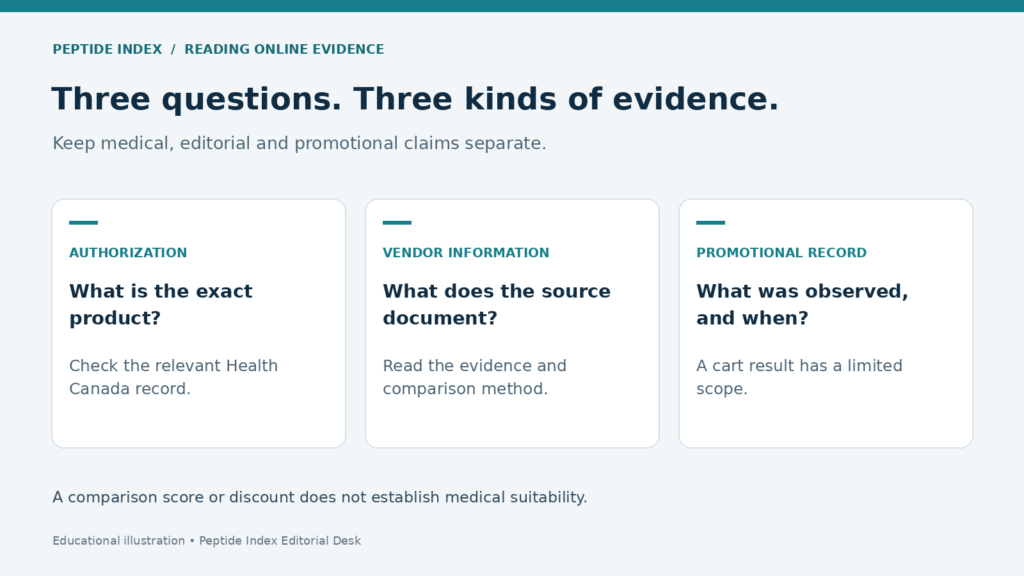

For a reader organizing information, the practical step is to record the exact product name and the source of any authorization claim. Avoid shortening everything to a broad category such as “peptides.” A category can contain information about medicines, laboratory materials and marketing claims without making those things interchangeable. If the source cannot answer the question you asked, leave the field unresolved rather than filling it with an assumption.
Read a comparison as an editorial tool
A vendor comparison can help collect information that would otherwise be scattered across several websites. Its usefulness depends on what it measures, where the information comes from and how clearly it explains missing evidence. A contact address, a published policy and a linked test report are separate observations. Combining them into a score does not turn the score into a clinical assessment.
Resources such as Peptide Index can be used as a starting point for organizing Canadian vendor information. The next step is to follow the relevant source and read the methodology behind the comparison. Ask whether a statement reflects a document the editor inspected, a claim supplied by the business or a detail that has not yet been confirmed. Those distinctions are more informative than a number viewed on its own.
Consider a hypothetical comparison with two entries. One includes a recent policy link but has no explanation of its testing documents. The other provides a report reference but gives little information about support. There is no reason to treat either entry as complete simply because it appears in a polished table. A careful reader can identify what is documented, what is absent and which missing information matters to the question at hand.
Give every document a specific job
Documents become easier to interpret when each has a defined purpose. A laboratory report concerns the sample and tests described in that report. A shipping policy describes stated delivery arrangements. A refund page sets out the business’s published terms. A review describes someone’s reported experience. None of those documents, on its own, establishes every other aspect of a business or product.
One simple research habit is to keep a short note beside each source: “This supports…” followed by a narrow statement. Then add “This does not answer…” for the unresolved question. For example, a screenshot of a shipping policy may show what the page said on a particular date, while leaving actual delivery performance unknown. That second sentence is often what prevents a reader from making an unsupported leap.
The same habit helps when information is missing. A broken report link is a reason to seek the document, not proof that the report never existed. A new page with few reviews has limited public history, not a settled reputation. Describing the gap accurately is more useful than turning uncertainty into either praise or accusation.
Keep promotional evidence in its own category
A promotional page answers a commercial question. If it documents a checkout observation, the relevant details include the code, date, conditions and displayed result. For example, the GROWTH10 verification record publishes dated information about a pre-payment checkout observation. That is a different type of information from a drug authorization record, a laboratory result or a report of a delivered order.
A reader does not need to dismiss promotional information to recognize its limits. The useful question is whether the evidence matches the claim being made. A recorded reduction in one cart cannot establish product quality, medical suitability or future availability. Keeping those categories separate lets readers use a narrowly documented fact without treating it as a wider endorsement.
It also helps to notice how presentation affects interpretation. A badge placed beside a product name can look broader than the evidence behind it. Read the sentence explaining the badge. If the explanation only concerns a checkout observation, retain that narrower meaning when making notes or sharing the page with someone else.
Check dates and relationships before sharing
An article’s publication date, an editor’s update date and the date of an underlying observation are different things. A page can be redesigned today while still referring to an older document. When the date matters, record the date attached to the evidence itself and the date you accessed it. This makes later corrections easier and helps another reader understand what was actually available at the time.
Commercial relationships also deserve attention. A sponsored contribution, referral arrangement or affiliate link is context for evaluating a recommendation. Disclosure does not automatically establish that a statement is accurate or inaccurate. It tells the reader something relevant about the relationship behind the presentation. Evidence still needs to be assessed on its own terms.
Before sharing a conclusion, try writing it in one sentence without using “best,” “safe” or “trusted.” State the source, the observation and its limit instead. If that sentence feels impossible to write, the evidence may not support the original conclusion. Clear boundaries make health information more useful: medical decisions remain with qualified professionals, editorial comparisons remain research aids, and promotional records remain records of a commercial observation.
Sources
[1] Health Canada — Drug Identification Number (DIN)
[2] Health Canada — Drug Product Database
[3] Health Canada — Think twice before injecting peptides bought online
Sources accessed August 30, 2026.

Dr. Dheeraj Yadav
Ayurvedic Physician & Certified Bach Flower Remedy Practitioner
Dr. Dheeraj Yadav is a licensed Ayurvedic doctor and certified Bach Flower Remedy practitioner with deep expertise in holistic and natural healing. He carefully reviews all health-related content on this website to ensure it is accurate, safe, and consistent with the principles of traditional and integrative medicine.
This article is for informational purposes only and does not constitute medical advice. Please consult a qualified healthcare professional before making any health decisions.