

Back Pain That Won’t Go Away After 2 Weeks — When to See a Doctor in India
Kanica Sharma
June 18, 2026

Back pain is the most common musculoskeletal complaint in India. According to national health surveys, it affects nearly 60% of Indian adults at some point in their lives — and the numbers are rising sharply due to desk jobs, long commutes, heavy lifting, and sedentary lifestyles.
Most episodes of back pain — around 90% — improve on their own within 4 to 6 weeks with rest and basic care. The remaining 10% persist, worsen, or come back repeatedly. Knowing which category you fall into is the key to deciding whether to wait or to see a doctor.
The 4 Most Common Causes of Back Pain That Won't Go Away
1. Muscle Strain or Ligament Sprain
The most common cause of lower back pain in India — particularly in younger adults — is a strained muscle or sprained ligament. It typically follows lifting something heavy, a sudden awkward movement, or long hours at a desk in poor posture. The pain is usually dull and aching, worsens with movement, and may cause muscle spasms.
Most muscle strains improve within 2 to 4 weeks. If your back pain has been present for longer than this after a muscle strain, or if it is severe from the start, it warrants medical evaluation.
2. Disc Problems (Herniated or Slipped Disc)
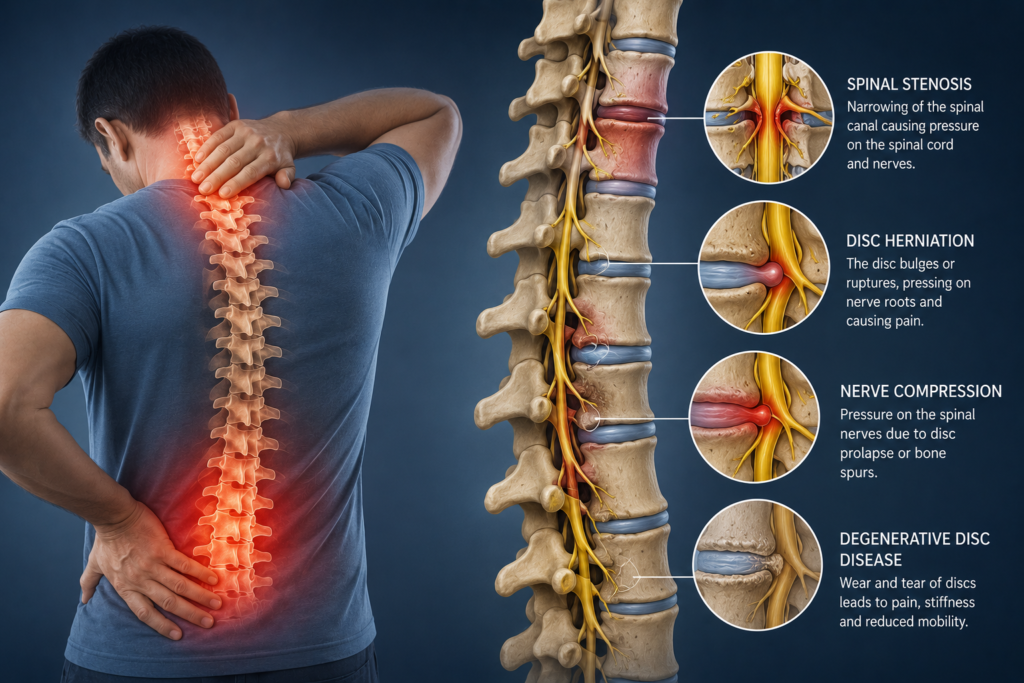
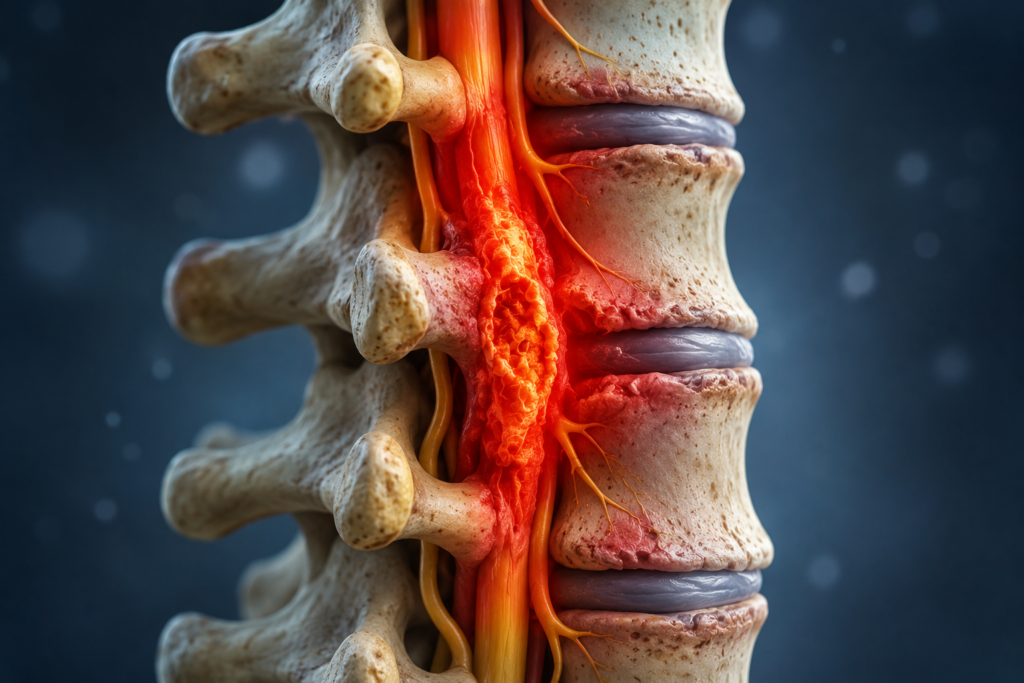
Between each vertebra in your spine sits a cushioning disc. When the soft inner material of a disc pushes through the outer layer — commonly called a slipped or herniated disc — it can press on nearby nerves. This causes back pain that often radiates down one or both legs (called sciatica), with numbness, tingling, or weakness in the leg.
Disc-related back pain tends to be more severe than muscle pain, often worsens with sitting or bending forward, and may improve when lying flat. An MRI of the spine is needed to confirm the diagnosis.
3. Spinal Stenosis
Spinal stenosis is a narrowing of the spinal canal that puts pressure on the spinal cord and nerve roots. It is more common in adults over 50 and causes back pain, leg pain, and weakness that typically worsens with walking or standing and improves with sitting or leaning forward. Many people with spinal stenosis find they can walk only short distances before needing to stop and rest.
4. Non-Mechanical Causes
A small but important group of patients have back pain caused not by the spine itself but by another condition — kidney infections, kidney stones, or in rare cases, a tumour. These causes are distinguished by certain features described in the red flag section below and require prompt medical evaluation.
Red Flag Signs — See a Doctor Urgently
Go to a doctor within 24 to 48 hours, or seek emergency care, if your back pain is accompanied by:
- Loss of bladder or bowel control — this is a medical emergency, go to a hospital immediately
- Weakness, numbness, or tingling that is spreading down both legs
- Back pain that is severe and constant, does not change with position, and is worse at night
- Back pain after a significant fall, accident, or direct impact to the spine
- Fever combined with back pain (possible kidney infection or spinal infection)
- Unexplained weight loss along with back pain — particularly in adults over 50
- Back pain that started after a history of cancer
- Back pain in a child or teenager — this is much less common and should always be evaluated
When to See a Doctor (Non-Emergency)
Book an appointment with a doctor if your back pain has:
- Not improved after 2 to 3 weeks of rest and basic care
- Been present for more than 6 weeks, even if it has improved partially
- Started interfering with sleep, work, or daily activities
- Returned repeatedly — more than 2 or 3 episodes in a year
- Any pain or tingling running down your leg, even without severe back pain
Which Doctor Should You See?
For most cases of back pain in India, your first appointment should be with an Orthopaedic Surgeon (bone and joint specialist) or a Spine Specialist. They will examine your back, assess your neurological function, and arrange X-rays or an MRI if needed.
If your back pain is accompanied by leg pain, weakness, or numbness, a Neurosurgeon or Neurologist may also be involved in your care, depending on the cause.
You do not need a referral in India — you can book directly with an orthopaedic specialist or spine surgeon at any major hospital.
Find a specialist near you: Find a Doctor
What Will the Doctor Do?
At your first appointment, the doctor will take a history of your back pain — when it started, what makes it better or worse, whether it radiates to the legs, and your general health. They will perform a physical examination of your spine and test your reflexes and sensation.
They may arrange: an X-ray of the spine (to check vertebral alignment and any obvious bony changes), an MRI (the gold standard for diagnosing disc problems and nerve compression), and blood tests if infection or inflammation is suspected.
Most back pain, even when caused by disc problems, is treated without surgery. Physiotherapy, pain management, and lifestyle modifications resolve the majority of cases effectively.
FAQs
Q: Is bed rest the right approach for back pain?
A: Complete bed rest is no longer recommended for most types of back pain. Short periods of rest (1-2 days) are reasonable during the most painful phase, but staying mobile with gentle activity — walking, light stretching — helps recovery. Prolonged bed rest weakens muscles and can slow recovery.
Q: Can back pain go away on its own without treatment?
A: Many cases of acute back pain — particularly muscle strain — do resolve on their own within 4-6 weeks. However, back pain that persists beyond 6 weeks, that is associated with leg pain, or that is severe should be evaluated by a doctor. Waiting too long for disc-related problems can sometimes lead to nerve damage that is harder to reverse.
Q: Will I need surgery for my back pain?
A: The vast majority of back pain — including disc herniations — is treated without surgery. Surgery is considered when there is significant nerve compression causing weakness, when conservative treatment has failed after several months, or in emergency situations such as cauda equina syndrome. Your doctor will discuss all options before any surgical recommendation is made.
This article is for informational purposes only and does not constitute medical advice. Always consult a qualified orthopaedic surgeon for diagnosis and treatment of back pain.
Dr. Dheeraj Yadav
Ayurvedic Physician & Certified Bach Flower Remedy Practitioner
Dr. Dheeraj Yadav is a licensed Ayurvedic doctor and certified Bach Flower Remedy practitioner with deep expertise in holistic and natural healing. He carefully reviews all health-related content on this website to ensure it is accurate, safe, and consistent with the principles of traditional and integrative medicine.
This article is for informational purposes only and does not constitute medical advice. Please consult a qualified healthcare professional before making any health decisions.