

How to Verify Peptide Discount Codes in Canada: Checkout Evidence, Dates and Reliability
Peptide Index
September 3, 2026

A page that calls a discount code “verified” should leave a reader with something more useful than a badge. There should be a way to understand what was observed, when it happened and which conditions applied. Without that context, the word can be mistaken for a guarantee that the page never actually establishes.
The distinction matters in health-related searches, where a commercial statement can sit next to language about product quality or personal benefits. A checkout record answers a narrow pricing question. It does not establish that a product is appropriate for an individual, that an order was delivered or that a medical claim is supported. Reading the evidence carefully starts by keeping those questions separate.
Different search terms can lead to the same question
“Coupon code,” “promo code” and “discount code” are common ways of describing text entered into a promotional field. The terminology alone says little about eligibility or the result. A page can repeat all three phrases without providing any additional evidence. What matters is whether the record identifies the particular code and the observation associated with it.
Begin by writing the claim in ordinary language. For example: “This page says a named code produced a reduction in a recorded cart.” That sentence is easier to examine than a broad label such as “best offer.” It directs attention to the cart, the date and the reduction instead of implying a comparison with every other offer that might exist.
This also helps when sharing information. Someone reading a short social post may not see the conditions on the linked page. Preserve the limits in the description you share, especially if you are relying on a past observation. An accurate brief description is more useful than an enthusiastic claim that becomes misleading when separated from its context.

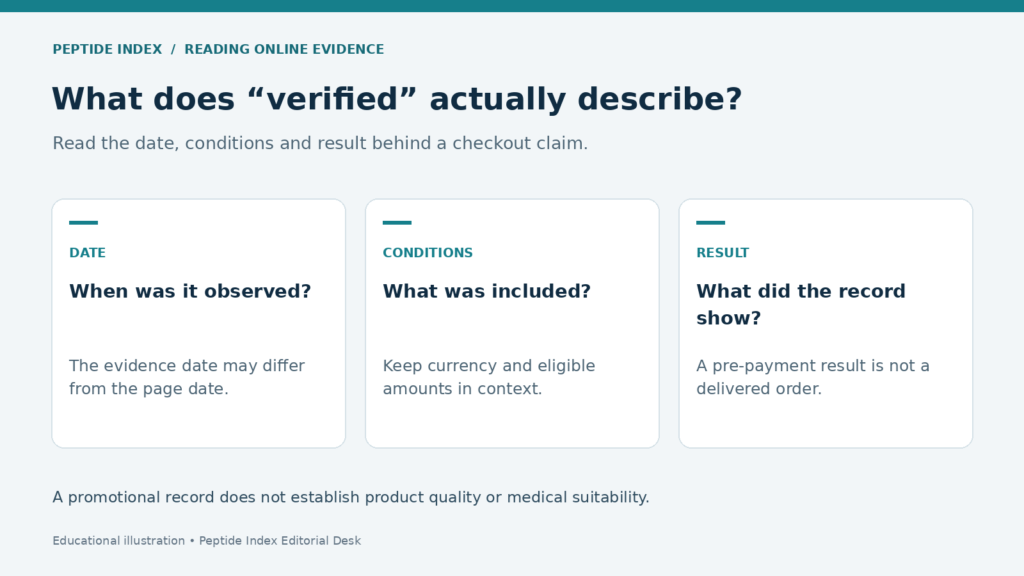
Look for the observation date, not just the page date
A website’s footer year does not establish when a checkout test occurred. Nor does an article’s recent update date necessarily mean its commercial evidence was refreshed. Find the timestamp attached to the actual observation, including the time zone if one is supplied. Keep it separate from the date on which you personally viewed the page.
The GROWTH10 checkout documentation provides an example of a resource organized around dated pre-payment observations and an archive. The useful reading task is to inspect the relevant record and its scope. Its published description does not turn an earlier observed result into a promise about every later cart or a completed purchase.
When dates differ across pages, do not assume that the newest-looking design contains the newest evidence. Check whether the pages refer to the same observation, different observations or an undated general claim. A small research note containing the URL, observation date and access date can prevent considerable confusion when information changes later.
Read what is included in the recorded conditions
A result becomes easier to understand when the record describes the cart context and the point in the checkout process at which the observation was made. Where available, note the currency, relevant subtotal and stated exclusions. If something important is not documented, mark it as unknown. Do not quietly assume a tax treatment, shipping charge or account condition that the record does not state.
The VIP10 checkout documentation offers another reference for examining the boundary between a documented checkout observation and broader storefront claims. Read its method and limitations alongside the result. Two code pages should be assessed on their respective evidence; similar branding or a similar displayed percentage does not establish identical conditions.
A pre-payment observation also has a clear stopping point. It is not evidence that money changed hands, that a shipment arrived or that customer service resolved a problem. Those events would require different records. Defining the stopping point is a useful habit because the familiar appearance of a checkout screen can make a partial process feel more complete than it is.
Compare the amounts without changing the assumptions
Consider a fictional cart with an eligible merchandise subtotal of CAD 200 and a stated reduction of 10 percent on that subtotal. The arithmetic produces a CAD 20 reduction and CAD 180 after that reduction. This example says nothing about taxes, shipping or excluded items. Those are additional facts that would need to be supplied before describing a final payable amount.
If a second fictional cart starts at CAD 220 and shows the same percentage reduction, its resulting merchandise amount is CAD 198. Matching percentage labels therefore do not necessarily mean matching prices. Likewise, two different percentages are not enough to compare offers when the starting amounts or included items differ. Keep the comparison on a consistent basis and label assumptions explicitly.
This is not an invitation to make a health decision around a discount. It is a way to avoid repeating an arithmetic claim that the displayed information does not support. A useful explanation shows the starting amount, the eligible base and the resulting reduction. If the available record cannot support that calculation, use a narrower description instead of inventing the missing number.
Read disclosures as part of the page
Affiliate and sponsorship disclosures provide context about commercial relationships. The Competition Bureau explains that material connections should be disclosed in influencer marketing. Readers should therefore look beyond the code itself and notice whether the page explains a relevant relationship. A disclosure is information to consider alongside the evidence, not a replacement for checking it. [1]
Avoid going further than the available facts when interpreting that disclosure. A recurring code, similar wording or a shared topic does not by itself prove who owns a website. If ownership is not documented, it remains unresolved. Evaluating the public claim is possible without making unsupported allegations about the people behind it.
Keep health decisions outside promotional comparisons
Health Canada’s warning about unauthorized injectable peptides bought online is a reminder that commercial availability is not a medical recommendation. A promotional code does not resolve questions about authorization or suitability. People considering treatment should discuss their needs with a qualified health professional and use appropriate licensed sources for prescribed medicines. [2]
Health Canada’s online-pharmacy guidance also directs Canadians to verify pharmacy licensing through the relevant provincial or territorial regulator. [3] That is a different verification task from checking a promotion. One concerns the source of medicines; the other concerns a commercial observation. A discount page cannot stand in for the first task simply because it documents the second.
Before relying on or sharing a code claim, write a short account of what the evidence actually shows: the named code, the observation date, the recorded conditions and the observed result. Add what it does not establish. That small discipline makes changing information easier to understand and keeps a promotional statement from becoming an unsupported claim about health, product quality or future service.
Sources
[1] Competition Bureau Canada — Influencer marketing and the Competition Act
[2] Health Canada — Think twice before injecting peptides bought online
[3] Health Canada — Safe use of online pharmacies
Sources accessed August 30, 2026.

Dr. Dheeraj Yadav
Ayurvedic Physician & Certified Bach Flower Remedy Practitioner
Dr. Dheeraj Yadav is a licensed Ayurvedic doctor and certified Bach Flower Remedy practitioner with deep expertise in holistic and natural healing. He carefully reviews all health-related content on this website to ensure it is accurate, safe, and consistent with the principles of traditional and integrative medicine.
This article is for informational purposes only and does not constitute medical advice. Please consult a qualified healthcare professional before making any health decisions.