

What a Peptide Certificate of Analysis Can—and Cannot—Tell You
Peptide Index
September 3, 2026

A certificate of analysis can look reassuring before anyone reads it. The laboratory name, numbered results and formal layout suggest precision. The real value, however, comes from connecting the document to a clear question: what sample was examined, what was measured and what conclusion the result supports. A report is most useful when the reader understands both its contents and its boundaries.
For Canadians researching peptide information online, this is a document-literacy task rather than a shortcut to a treatment decision. A publicly posted report may be relevant to evaluating a specific claim, but it should not be treated as permission to use an unauthorized product. Reading carefully begins with the document itself, before moving to the marketing language surrounding it.
Identify the report before interpreting the result
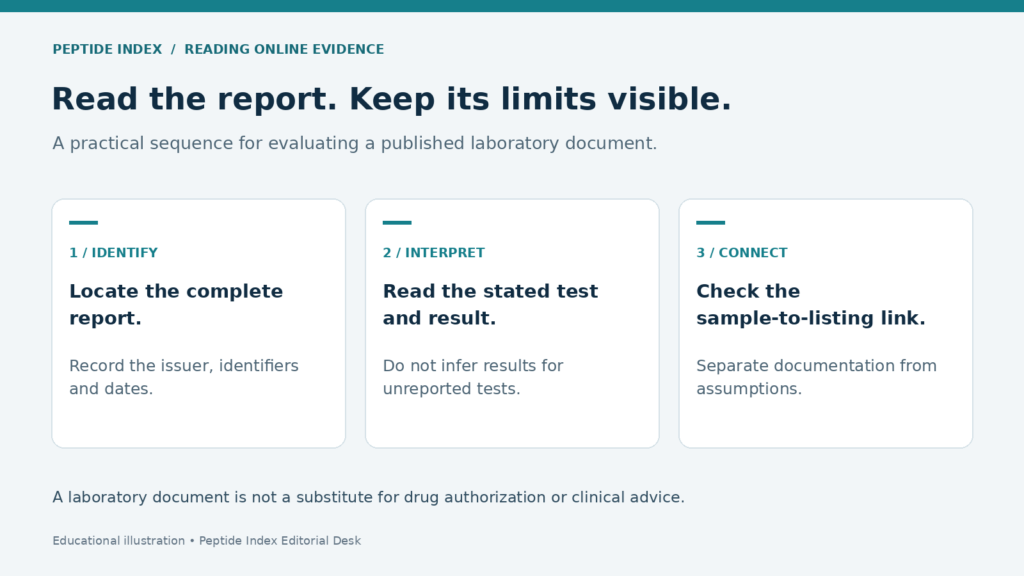
Start with the basic identifiers shown on the document: the issuing laboratory, report or task number, sample description and relevant dates. Copy them accurately into your notes. If the page only displays a cropped image, look for the complete report. A small screenshot may omit information that changes how the visible result should be understood.
Authentication is a separate task from interpretation. Janoshik, for example, provides a report-verification page using a task number and unique key. Checking a report through the laboratory’s own channel can help establish whether the document corresponds to its record. It does not, by itself, answer every question about how the sample was selected or whether a later item is the same material. [1]
Keep the original source URL with your notes rather than saving only the image. If you later return to a different version, the URL and access date help explain what you previously reviewed. When a verification check cannot be completed, describe that specific limitation. Do not turn an unsuccessful lookup into a claim of forgery without further evidence.

Ask which question the test actually answers
Laboratory terms describe different measurements. The question “What substance was identified?” differs from “How much was measured?” and from “What did the purity analysis report?” A reader should not substitute one answer for another. Consult the report’s stated methods, units and scope, and ask the issuing laboratory for clarification when the terminology is unclear.
As a regulatory reference, Health Canada’s good manufacturing practices guide discusses certificates containing test results and specifications within a broader pharmaceutical quality system. That wider framework is important context: a certificate is one part of documented quality control, not a replacement for all manufacturing and regulatory requirements. The guide should not be presented as certification of a vendor simply because that vendor posts a report. [2]
Suppose a hypothetical promotional image highlights one impressive percentage while leaving the test description outside the crop. The appropriate next step is to find the complete document and identify what the percentage measures. It is not to infer the amount in each container, the performance of an unreported test or a health outcome. The missing context is part of the question, not an inconvenience to ignore.
Follow the connection between sample and listing
After reading the report, examine the connection the website makes between that document and the item being discussed. Does the listing show a batch identifier? Does the report contain a corresponding identifier? If the descriptions differ, is there a documented explanation? A shared product name alone leaves more uncertainty than a clearly explained link between the records.
Even matching labels do not answer every question about sample selection. Who submitted the material, what information accompanied it and what handling history is documented? These questions matter because the report’s result relates to the submitted sample. Readers should distinguish a stated connection from one they can independently check, and avoid describing the entire supply chain as verified on the strength of a single file.
A useful way to organize this work is to maintain two short notes. The first records the laboratory’s findings as stated. The second records the website’s explanation of why the report applies to its listing. Keeping them separate makes it easier to spot where the document ends and the seller’s representation begins. It also makes an unanswered question much easier to formulate.
Use comparisons to find documents, then read the originals
An editorial directory can reduce the effort of finding vendor pages, policies and published testing references. Canadian vendor information at Peptide Index is one place to begin that broader research. Treat any summary as a navigation aid: return to the underlying report for the actual result, identifiers and limitations before relying on a specific technical claim.
Comparison tables inevitably compress information. A short field such as “testing available” may not tell you which product, batch or date is covered. Instead of reading the field as a complete assessment, use it to locate the document and finish the question yourself. If the methodology explains what the field means, retain that definition when comparing entries.
This approach also makes corrections constructive. Rather than telling an editor that a vendor is “wrong” in general, identify the particular listing, the report you reviewed and the mismatch. A precise correction can be checked and acted on. It avoids turning one incomplete field into an unsupported judgment about everything the business does.
Keep checkout records separate from laboratory records
Different evidence can appear on the same website without answering the same question. A VIP10 verification record concerns documented checkout information. A laboratory record concerns the reported examination of a sample. A code being accepted does not validate a certificate, and an authentic certificate does not establish current promotional eligibility.
That separation is useful even when both records are clearly presented. Imagine someone forwarding a link with the message “It has been verified.” Before relying on the statement, ask what “it” refers to: the report’s authenticity, a particular measured result or a checkout observation. Replacing the broad word with the exact verified fact usually reveals what remains unknown.
Write a conclusion no broader than the evidence
A careful conclusion might say that a named laboratory report lists a particular result for a described sample, and that the document could be authenticated through the laboratory’s service. It should separately explain whether the relationship to a vendor listing was documented. This may sound less dramatic than a blanket endorsement, but it is far more useful to the next reader.
Finally, a test report should never be treated as a substitute for clinical guidance or authorization. Health Canada’s warning about unauthorized injectable peptides sold online remains relevant even when promotional pages display testing documents. [3] If your underlying question concerns your own health, bring the exact product information to a qualified professional. For editorial research, keep the report, its identifiers, its limits and any unresolved questions together.
Sources
[1] Janoshik — Report verification
[2] Health Canada — Good manufacturing practices guide for drug products (GUI-0001)
[3] Health Canada — Think twice before injecting peptides bought online
Sources accessed August 30, 2026.

Dr. Dheeraj Yadav
Ayurvedic Physician & Certified Bach Flower Remedy Practitioner
Dr. Dheeraj Yadav is a licensed Ayurvedic doctor and certified Bach Flower Remedy practitioner with deep expertise in holistic and natural healing. He carefully reviews all health-related content on this website to ensure it is accurate, safe, and consistent with the principles of traditional and integrative medicine.
This article is for informational purposes only and does not constitute medical advice. Please consult a qualified healthcare professional before making any health decisions.